
Lloyd’s Register publishes Recommended Practices for Floating Offshore Wind Turbine Support Structures
Lloyd’s Register (LR) has published its first Recommended Practice for Floating Offshore Wind Turbine Support Structures marking a significant milestone in the rapidly expanding floating offshore wind sector.
Developed in alignment with established international codes and standards, including IEC 61400-3-2 and the ISO 19000 series, Lloyd Register’s RP facilitates the development of floating offshore wind turbines (FOWTs). The document offers invaluable guidance across the entirety of the project lifecycle, encompassing critical aspects such as site condition assessment, design, manufacturing, transport, installation, commissioning and operation of FOWTs.
Neil Morgan, Offshore Wind Engineering Manager, Lloyd’s Register, said, “At Lloyd’s Register, we have actively supported the development of floating wind energy since its inception. Today, we are engaged in numerous projects within the sector, spanning from approval in principle to prototype designs slated for installation.”
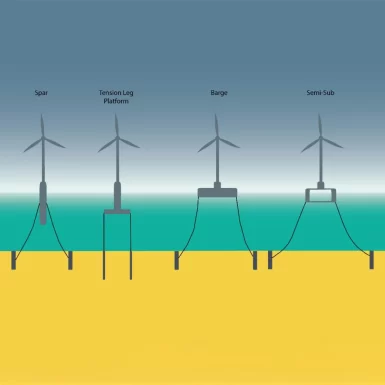
The assets covered within the scope of this Recommended Practice include the integrated floating wind turbines (i.e. floating substructure, tower with associated Rotor-Nacelle Assembly [RNA], and loads) and station-keeping systems (including mooring lines and anchors). The dynamic portion of cables is also considered, given the relationship with floating turbine motions.
Sean Van der Post, Global Offshore Business Director at Lloyd’s Register, said, “With the launch of our offshore floating wind recommended practices, Lloyd’s Register can further support ongoing initiatives and future clients in their pursuit of sustainable offshore wind energy solutions, empowering stakeholders with the necessary knowledge and insights to navigate the complexities of the offshore wind sector.”
Sections within the document include:
- Introduction
- Design requirements
- Design considerations
- External conditions
- Integrated loads analysis evaluation and load effects
- Structure design requirements for floater types
- Floating stability
- Station-keeping system design
- Materials
- Corrosion protection
- Tower
- Dynamic cable design
- Manufacturing
- Transport and installation
- Commissioning
- Operation and maintenance
- End of design life
Download the PDF: Recommended Practice for Floating Offshore Wind Turbine Support Structures